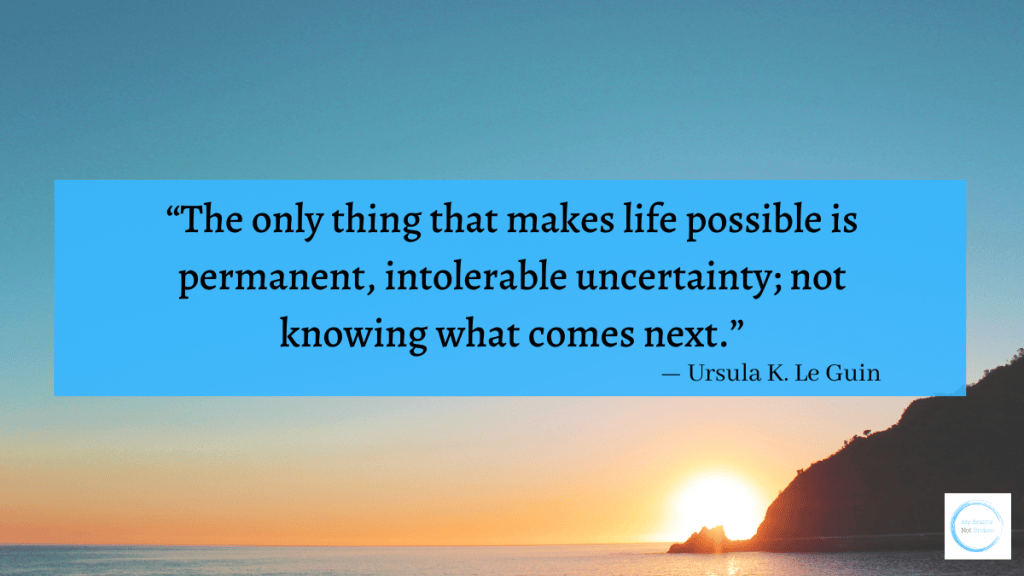
Why do we do the things we do? It’s a pretty broad question, and one I’ve often asked myself before. Wondering about the reason behind our words or actions is fairly common, especially when a person is dealing with mental health challenges. It’s human nature to want to know the reason behind things; to understand the why. And in our pursuit of finding that why, we tend to create a black-and-white way of looking at things. But sometimes we don’t know what to do when we can’t find a reason – and that is what I want to talk about today.
It’s human nature to want to know the reason behind things, but anxiety and depression don’t always offer us the reasons we’re looking for. We often have to deal with the symptoms, with tendencies or triggers that get activated. Over the years, as people learn more about themselves or how to live with a mental illness, they might be more attuned to the reasons behind some of these things. But early on in a mental health journey – or even years down the road – we can still find ourselves without a reasonable explanation for why we’re feeling a certain way.
And that isn’t always a bad thing. Frustrating, yes, but not always bad. Because at the end of the day, there is often a reason or an explanation. But when there’s not, there’s an assumption we tend to make – and that there’s no reason for why we’re feeling this way, and that it is completely nonsensical that we’re acting or feeling a certain way.
Early on in my mental health journey, a common mistake I would make is assuming that when I couldn’t find a reason or explanation for something, I was convinced it’s because the reason didn’t exist. Why was I sad today? I had a few minutes to think about it and if I didn’t determine a reason, then I was the problem. I was sad for no reason. I was anxious for no reason. And if there was no reason, I thought at the time, then there wasn’t a going to be a solution.
What I was being too stubborn to admit to myself, and a problem I think a lot of us run into, is that we don’t push back on that false narrative. Looking back, I started to learn how most often times, there probably was a reason I was feeling that way at the time, I just didn’t know it then. For instance, if I was feeling depressed, and I couldn’t figure out why, then a reason didn’t exist. It was as if a reason couldn’t exist unless I also defined it and made it make sense to me. And while it made sense that this was my conclusion, I am hoping to grow in the way I deal with those feelings.
Over time, I have gotten more comfortable with not knowing (I wouldn’t say I actually am comfortable, but that’s a post for another day). Why? Because most of the time, there was an explanation – it just wasn’t one I wanted to hear. Sometimes, the reason was simply: I have depression. Or I have anxiety. Sometimes the reason was deeper than that, but sometimes it wasn’t. Either way, I stopped stressing – at least, as much as I was able. Just because I don’t know a reason for things doesn’t mean a reason doesn’t exist – and I’m growing more comfortable with acknowledging that truth. I’ll figure it out one day. And if I don’t? Well, as I’ve learned, there are plenty of other things to worry about – trust me on that.


Thank you for your insights and your advocacy – makes all the difference!!
LikeLiked by 1 person
Thank you, I appreciate that!
LikeLike
Nice Post.
LikeLiked by 1 person
Thanks!
LikeLike