Getting Unstuck with Traci Edwards

CW: This post discusses mental illness and suicide.

One thing I enjoy about this blog is the chance to learn about other people’s approaches to mental health and wellness. Today, I’m sharing an interview with Traci Edwards, who recently started her own digital project, Let’s Get Unstuck, to create an online community in support of others who feel “stuck.” 

In your own words, how would you describe Let’s Get Unstuck?

[Let’s Get Unstuck] is a space for people who feel stuck and are looking for ways to get their lives back on track.

It’s a safe place to be vulnerable, free from judgement, and supported. A place to share their stories without criticism or fear. To learn from others how to gain back their power from painful moments. How to turn their pain into purpose and power. A place for shared stories to help others work through struggles. I want to find the right voices to tell the right stories that can relate to as many people as possible and pull them back into a place of hope and get them believing in possibility again. 

What do you hope people will gain from your project, and from your perspective?

Image of woman in chair, smiling
Traci Edwards (image courtesy of Traci Edwards)

I want people to gain a true connection with me, but also with other people who share similar values of spreading goodness and compassion to others. I want people to gain a new safe space in a digital community where they can be vulnerable, honest and feel unjudged. A place to tell their truth and to know that they will receive love and kindness in return. My space is not for harsh critics and to tear others down. I also want people to gain perspective from others about topics they struggle with. Tips, tools, advice that helps them through a tough time. I know this exists in more established websites and I want to make this one of those sites, but always upholds integrity and authenticity. 

If anyone can gain anything from me, then I am doing my part. I had no expectations when I started writing; only that I want to help others through dark times and in return, I can learn something new that can perhaps help me. I want people to walk away with hope. To find their confidence and self-worth again. I want them to know it’s okay to be off track and stuck, that they aren’t alone. I also want them to feel supported which is why I share relatable stories and tools that can help them move toward getting unstuck. I only know what has worked for me, which is what I want to share with everyone.

When it comes to mental health, why is it so important for people to share their stories?

[People’s] stories can very well be the one thing that gives someone struggling another day to live. People really do not fully understand the power behind their words. I literally had a young 25 year old girl write to me the other day asking me for help. She had connected with something that I wrote. I had to explain to her that I was not a therapist but I would most certainly be there to listen. The sweet young woman was unsure about her life as she felt unloved, unwelcomed and unneeded. She was in a very dark place of depression and told me she isn’t sure if she wants to live anymore. The first thing I did was provide her with a group for people that could guide her to the right therapist b/c she asked me for help. Then I just listened to her and asked her simple questions. She was so taken back that I was willing to give her a stranger time to unload and to just be heard. We spoke for a while. She said “thank you that you care thank you”. This all stemmed b/c of a story I shared. That is the power of our writing. That in one moment it captured someone in a way that helped pull someone back from a ledge. That is why people should share their stories. To help others. Bottomline. 

Why does mental health matter to you?

I lost my best friend to suicide when I was 14 and he was 15. Far too young! Then another one a year later to suicide. Similar in age. Throughout my years, hearing friends lose friends or family members to it as well. Then you see well-known celebrities broken on the inside when appearing well put together on the outside taking their own lives as well. Then recently I lost an ex who I once loved very much to this as well. 

People feel broken, this world feels so small to them, that pain will not pass and they feel alone. This breaks my heart! I am a person who wants to help, it’s just part of who I have always been. When I see someone I know feeling empty inside I want to be that person to help pick them up. So, when suicide keeps coming up it makes me feel like I could have or should have done more. 

I personally have been battling with anxiety since my 20s and I have family members with major depression and I see them struggling a lot. It scares me to think that one day they won’t be here because the pain outweighs everything else.

People feel helpless and don’t feel safe to speak about what they are struggling with. There needs to be more compassion in our crazy world, more places to allow for vulnerability and non judgement. All of this is connected to mental health. I want to provide that space! More people should want to provide that type of space.

Is there anything else you’d like to add?

I started this journey to get unstuck. Now, I’m meeting so many inspiring people who are teaching me (indirectly) how to inspire others. I am not a coach or a therapist, but I do want to become a voice in the personal development and growth space. I feel my story could help others learn to never give up, that there is hope again and possibilities are all around us once we can shift our mindset and be more open. And even in the darkest of moments you will eventually find that light that takes you into your new chapter with grace and confidence. You will reestablish a relationship with your self-worth again and become that driving force that always existed within. 

You can follow Traci’s journey on her blog Let’s Get Unstuck, as well as her Substack.
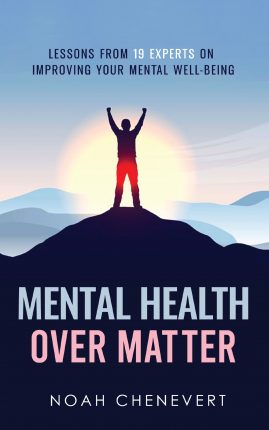
Mental Health Over Matter: An Interview with Noah Chenevert

I recently got the opportunity to connect with Noah Chenevert, a mental health advocate and author of the recently published book “Mental Health Over Matter.” In this interview, we talked about the book, Noah’s approach to mental health, and his attitudes surrounding mental health in the current day and age. Thanks for taking the time, Noah!

The cover of Chenevert’s new book, “Mental Health Over Matter”

Congratulations on the recent publishing of your new book, Mental Health Over Matter! For those who haven’t read it, how would you describe this book?

Mental Health over Matter is a holistic book about the many areas influencing mental health. Nineteen experts demonstrate how individuals can stimulate their mental health in different areas such as exercise, sleep, and nutrition but also news, psychedelics, and sex.

What inspired you to write a book about mental health, and to have these thought-provoking conversations?

There are three major reasons why I decided to write this book:

  • Mental health is an extremely important topic and the number of people with mental health issues continues to increase. Many individuals need help but can’t (immediately) afford mental healthcare due to insufficient supply or budgetary constraints.
  • I found that a holistic view of mental health was missing. Good mental health is the sum of adequately incorporating many different practices. You can sleep and eat well, but your mental health will still suffer if you neglect other areas.
  • Improving my habits and lifestyle in these 19 areas has helped me/people around me the most. I wanted to share the wisdom, tools, and ideas of experts for everyone to learn from.
Noah Chenevert, author of the book "Mental Health Over Matter".
Noah Chenevert (photo via Chenevert)

Despite a change in attitude toward mental health in recent years, the mental health stigma still exists. Why do you think that is?

Although the overall attitude towards mental health does improve, the mental health stigma is unfortunately quite persistent. I have two explanations. First, many people still associate impaired mental health with ‘weakness,’ as if individuals (especially men) should always be strong. Depression or anxiety is not “sexy.” This often results from traditional beliefs which are fueled by toxic masculinity. Second, people still tend to underestimate the importance of mental health. If I break my arm, people can see that I’m injured. But when I would have severe anxiety or depression, it is more difficult for others to understand what I’m going through.

What is your approach to your own mental health?

At the end of my book, I identify nine overarching lessons that offer rules, attitudes, and guidelines you can adopt in your life to improve your mental health. Perhaps you will realize that you have already incorporated some of these lessons while others are new to you. (See attachment for the nine lessons)

What are the most important things that contribute to good mental health in your life?

I take a layered approach to mental health. The first layer consists of a good diet, sleep, and exercise. My mental health tends to suffer if I don’t pay enough attention to these three aspects.

The second layer is relationships/connections. A meta-analysis concluded that ‘the influence of social relationships on the risk of death are comparable with well-established risk factors for mortality such as smoking and alcohol consumption and exceed the influence of other risk factors such as physical inactivity and obesity’ and that ‘physicians, health professionals, educators, and the media should […] take social relationships as seriously as other risk factors that affect mortality. The third layer consists of other practices, such as going out in nature, mindfulness, and many other activities that have a good effect on your mental health.

If you could give one message about mental health and wellness, what would it be?

Focus on what works for you. Many people out there try to convince you that their way is “the magic solution.” But there is no uniform fix. What works for me might not work for you. And what works for me now might not work for me in a few years. We each must find our own way.

You can received more information about Noah’s book, “Mental Health Over Matter,” on his website.

Reading and Mental Health

As a kid, I loved to read. While I had favorite authors and genres, it came to a point where it almost didn’t matter what kind of book it was – if I hadn’t read it before, odds were that I’d give it a shot. I’d guess that I’ve read hundreds of books in my lifetime, but the vast majority of them happened before I went to college – and I had to deal with my mental health.

When my mental health worsened, it became hard to read. I had difficulty concentrating on one task at a time, and the result was many years of multitasking. I would have music on while studying, or stream a show on Netflix while doing some writing. I could not focus on a sole subject or interest because I could not develop a one-track mind. Instead, I would have two thought processes running in my head: 1) the normal thoughts and feelings about what it is I was doing at the time, and 2) the negative thoughts and self-talk that seemed to be popping up more and more every day.

By multitasking, I was occupying both thought processes and keeping my mind fully occupied and away from the negative thoughts. But reading a book meant that I would have to develop a one-track mind that concentrated on the words on the page – a near-impossible ask for my anxious self.

This meant that over the course of my college career, I read very little outside of what was required for school. After college, I tried to get into reading a little more, but it proved to be too difficult. I thought that I had to be busy all the time in order to combat the negative thoughts, and the result was an unhealthy lifestyle that definitely didn’t make me feel better about myself. So, like in many other aspects of my mental health and my life, I took a new approach.

First I started rereading books that I’d enjoyed in the past. Some were easier to read than others, but it helped me get on a good schedule of reading consistently because even if I didn’t enjoy it, I’d already read the book before so it wasn’t a total waste.

When 2019 started, I decided to take a chance and really get into reading again. I started by making it a goal to read only 10 pages a day. It was a small chunk, but it was manageable and made me feel like I’d accomplished something. Soon, I started reading during my lunch break at work, which satiated my need for multitasking while helping me learn how to focus on reading.

It’s taken a few months, but I’ve finally hit my groove. I’ve read four books so far in 2019 and I just started my fifth, and while I’m not in love with reading like I used to be as a kid, I like it a whole lot more than I have in recent years. I hope that as my mental muscles grow stronger I can read not only as a coping mechanism but because I genuinely enjoy it.

Has your mental health affected a hobby or activity that you love? Let me know in the comments!