Do The Things You Love

I absolutely love live music. I’m not the most musically proficient person (I played the saxophone in middle school and sang in a boy choir until puberty hit), but something I discovered when I reached adulthood was that I love going to live shows. Since a majority of the bands I like are smaller acts, that meant I was hitting small clubs and intimate venues in tons of cities listening to my favorite bands and songwriters.

I’ve had different concert buddies over the years, but there have always been people willing to go see shows with me. One constant concert pal is Kevin, who I’ve seen tons of shows with. We had a particularly crazy stretch where we saw three concerts at three different venues over the course of eleven days. And it ROCKED.

This slideshow requires JavaScript.

It’s hard to describe what going to a live show does for me. I think the biggest thing is that, for a few hours, it seems like nothing else matters. It’s just me, the people around me, and the band putting on their show. Everything else takes a back seat. All my problems and worries are set to the side while I immerse myself in the music.

An annoying symptom of depression is that sometimes you don’t enjoy things the way you used to. Over the years, that loss of joy has happened with a lot of things. I have fought to enjoy things I once loved, and don’t enjoy certain activities quite like I used to. So when I do find something I love to do, I hold on to it as tightly as I can.

We all have things we love to do – activities, pastimes, whatever you want to call them. There are things out there that make us feel alive, at peace, content – happy. Oftentimes, after we do those things, we think to ourselves I should do this more.

And you’re right. You should. Not just because life is short and you should make the most of your time (though that is a good reason), but because you deserve it. You deserve to do the things you love because it’s another reminder that you’re a human who loves things – just like everyone else. We all deserve it. So what’s stopping you?

I love to travel, write, and see live music. What are the things YOU love to do? Let me know in the comments!

#BellLetsTalk: An Important Movement

If you were on Twitter yesterday, you might have seen the hashtag #BellLetsTalk. It appears once a year, and it’s a beautiful thing. When you tweet #BellLetsTalk, for every retweet you get, 5 cents were donated toward mental health initiatives in Canada. That might not sound like much, but when the results include 145 million impressions, more than 7 MILLION dollars ended up being donated!

I’ve seen #BellLetsTalk pop up more since I’ve started this blog, and it’s encouraging to see. One of the most important ways to combat mental health is by reducing the stigma surrounding it. Bringing in as many people into the conversation as possible is an important step that can go a long way toward having more involved conversations about mental health. I’d encourage you to check out the hashtag and I hope you see why it’s important to have this conversation regardless of whether or not you personally have a mental illness.

Mental health is important for everyone because it touches all of our lives in one way or another – whether we know it or not. Mental illness might affect every 1 out of 5 people in the United States, but mental health affects 5 out of 5 people. We all have to deal with keeping ourselves happy and healthy regardless of whether or not we have a mental illness. Pushing mental health away because we don’t think it applies to us is an unsafe choice that could have serious ramifications on our long-term health.

For my Canadian readers, I’d encourage you to check out Bell Let’s Talk and see what they’re all about. If you’re in the States, the National Alliance on Mental Illness is still one of my favorite places for information and resources, but there are tons of other sites and organizations that offer mental health information and services. I love to see when mental health conversations become a national topic, but it’s also important to know that these conversations are continuing every day online, in-person and on social media. And if you don’t know where to start, I’m happy to help.

#BellLetsTalk #LetsKeepTalking

healthyattitude


I’m Not Sorry About My Mental Illness

I apologize a lot. I mean, a LOT. I’ve done it so much that it’s like a reflex now – I say sorry without even thinking why I’m doing it.

And I apologize for everything. If I’m running late, I say sorry. If I misunderstand what someone said to me, I say sorry. If I don’t do as good of a job on something as I think should, I say sorry. I know it’s not what I should be doing, but I do it anyway. I don’t even consider whether or not I am actually sorry – it’s out of my mouth before I have time to think.

The one thing I apologize for constantly, and above all else, is my mental health. I say sorry when I can’t meet up with a friend because I’m depressed. I apologize that I wasn’t more social when I’m out because my anxious mind is doing cartwheels. If I have a panic attack in front of someone, I’m more concerned with whether or not that person is okay instead of trying to calm myself down. It’s not good for me – and I want to stop.

I want to stop because of all the people who have told me not to say sorry. They don’t want me to apologize for my mental illness – they just want me to be okay. And over the years, I missed that. I prioritized things incorrectly, and it stopped me from dealing with my mental illness in a healthy way.

Yes, apologize for the mess-ups. For the mistakes you make. But don’t apologize for who you are. I was ashamed of my mental health for a long time, and it held so much power over me. Now that I’m not ashamed, that power is gone. Yes, it’s still something I deal with, but I’m not afraid to deal with it. I’m not sorry. Hope that’s okay.

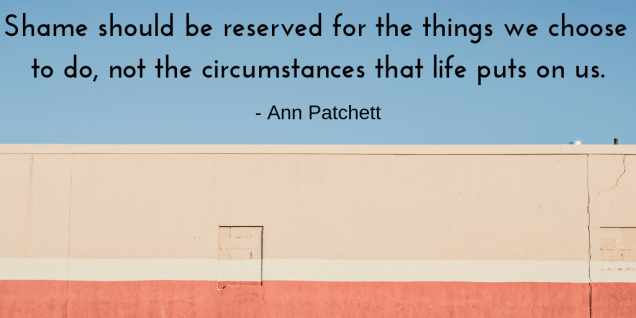
ann patchett

Five Things to Do When Depression Hits

There’s no doubt about it, depression sucks. Whether it’s having no energy, not enjoying anything, crying for no reason or just wishing you weren’t here (fun STUFF am I right?), there are plenty of symptoms that can be a sign that something is off.

When depression hits, I try to fight it. I’m not saying I’m always successful, but I do make the effort – much more than I used to. And I’ve learned a thing or two over the years about what can help turn a depression day into a (somewhat) normal day. That might not sound like much, but to me, it’s enough. Here are five things you can (try to) do when depression hits you like a ton of bricks.

Get out of bed

Depression can sap you of your energy and make you not want to do anything – even something that seems as simple as leaving your bed can be a monumental task. It’s not always easy, but getting out of bed and interacting with the world can go a long way. It’s easy to stay in bed when you’re tired or you want extra sleep, but when you feel crippled by depression and don’t want to leave, that’s a sign that you might need help. I’ve had many days where I feel like I didn’t accomplish anything, but when I remember that I got out of bed and chose to be a human – that day gets a little easier.

Eat healthy foods

Eating healthily might sound like a pro tip for the general public, but it can also help improve your mental health. Sometimes when I’m depressed, I have the urge to eat junk food until my stomach is sick – making me feel as bad physically as I do mentally. Seeing the link between mental health and physical health is an important step toward self-improvement. If you can improve how you feel physically, that may help how you feel mentally.

Tell someone

It’s important to tell someone that you’re feeling depressed or having an off day. No, they are not responsible for making the depression go away. Sometimes there isn’t anything they can do at all. When I am depressed, I feel like I’m all alone – that no one else is going through what I’m going through. Since in reality, that’s not true, reminding myself that I’m not alone is paramount to getting through the depression. Having someone out there that knows how you’re feeling can go a long way, and make you feel less alone in your struggle.

Exercise

I’ve talked about physical wellness before, but it’s an important aspect of getting out of that depression funk so I don’t want to gloss over it. Please know that when I say exercise, I don’t necessarily mean hitting the gym and lifting weights. Any form of exercise can be helpful to someone who’s depressed. Going for a run, doing yoga, biking outside, or even just taking a walk around the block can help keep those depression symptoms at bay. Try to do get some exercise when you’re feeling down – it’s more important than you think.

Practice Coping Strategies

We all have different coping strategies for dealing with mental illness. Over the years, I have found what works – and what doesn’t work – when it comes to my depression and anxiety. But that came after a process of trial and error. Use this time to practice coping strategies that you’ve learned from friends, therapy, the Internet, wherever. They might not all work. That’s okay! You practice them so you can see what works for you. Everyone’s different and oftentimes, it doesn’t matter what you do to cope with depression as long as it’s healthy and keeps your feelings at bay.

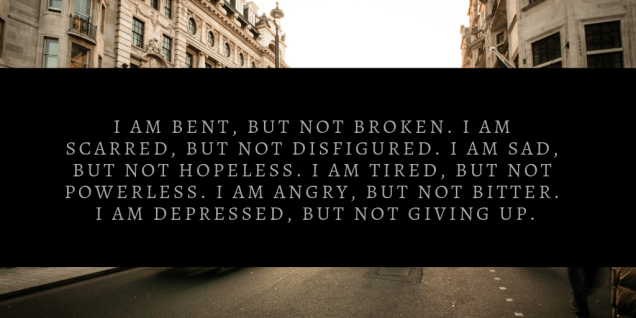
i am bent, but not broken. i am scarred, but not disfigured. i am sad, but not hopeless. i am tired, but not powerless. i am angry, but not bitter. i am depressed, but not gi

Guest Post: Healthy Ways to Cope With Mental Illness

This week’s post comes to us courtesy of freelance writer Patrick Bailey.

Having a mental illness can be terrifying. Most people who deal with a mental illness are stuck inside their own thoughts. They are constantly struggling with anxiety, depression, stress, irritability, mood swings, and more. It can be tough to manage a mental illness, which is part of why so many people self-medicate. They use drugs or alcohol to cope with a mental illness. If you have done this, it is helpful to know there are holistic treatment facilities available to help you overcome and treat the addiction and mental illness.

Knowing Your Limits While Still Using Your Strengths

One of the healthiest ways to cope with mental illness is knowing your limits while still using your strengths. Not everyone can handle stress well and that is alright. You might not accomplish quite as much as someone else in one day. That is okay too. This just means you probably have a lot of patience.

Maybe you can’t seem to focus on numbers or other similar activities, but you might be creative. Use that to your benefit. Allow your creativity to come out. Use your creativity to help you find new ways of getting things done.

Most people who suffer from a mental illness pay close attention to details. This happens a lot with autism, OCD, and other mental health illnesses. You can use your attention to detail to help yourself. Pay attention to how you act in the mornings or the evenings. How do you act in the middle of the day? What happens when you do something in a certain way? What happens when you talk to someone special in your life? Allow yourself to explore what routines and other things in life benefit you the most.

Many people with a mental health illness only accomplish half of what others do in one day and that is alright. Everyone is unique and you don’t need to compare yourself to others. You have your limits and you can stick to those. From now on, just keep using your strengths each and every day.

Radical Acceptance

Have you ever tried radical acceptance? This is when you completely accept something in all your being, with your entire mind and heart. When you know that it doesn’t matter what you do, a situation won’t be changed, that awareness can help. This can be used in cases of mental illness. If you have a mental illness and you know this with all your being, don’t try to force yourself out of it. That is only going to create more chaos.

Accept the mental illness. Use the strengths you have to keep going in the best ways you can. Pretending you don’t have a mental illness will only make things worse. By accepting the illness and what it means for your life, you can find the best ways to live with more happiness. This doesn’t mean you can’t change anything, it just means some things are out of your control.

Opposite to Emotion Thinking

Opposite to Emotion Thinking is just what it seems like. You will act in ways that contradict what your emotions are telling you. For example, if you are angry and you want to get away from everyone, don’t do it. Go spend time with your best friend. Do the opposite of what you want to do. If you are feeling anxious and want to get sleep, do the exact opposite. Find something fun to do. If you are feeling manic, don’t act out in a destructive way. Choose to do an activity that provides you with more stability. Mastering Opposite to Emotion Thinking can be tough, but with practice, you can do it.

Using Your 5 Senses

Some of the most common mental health illness symptoms include irritability, anxiety attacks, panic attacks, stress, and manic episodes. It can be tough to practice using all your 5 senses, but the benefits can be tremendous. When you experience symptoms of the mental illness, stop for a moment. Think about what you smell, what you feel, what you see, what you hear, and what you can touch. Explore all your 5 senses and let those override your mind. This might help to reduce the symptoms you are experiencing.

Getting Treatment

If you are experiencing symptoms of mental illness, getting treatment may be the best route. There are far too many people who suffer alone in silence. They hide their mental illness and may not even tell their loved ones what is going on. You don’t have to do that. You can get the help you need to learn how to cope with your illness in healthier ways.

Having a mental illness may be tough. You may feel isolated or alone, but you aren’t. There are many people who care about what you are going through. There are many people who want to help you in managing your mental illness.

You can find more of Patrick Bailey’s work on mental health, mental illness and substance abuse at http://www.patrickbaileys.com.

 

New Year, New Me? Nah.

“New Year New Me” is a phrase often used around the start of any new year, and it makes sense. Though some people just see it as one day becoming another, for others it’s a chance to start fresh and work on good habits and self-improvement. The start of a new year can be cathartic for some who may want to leave the previous year behind and begin anew. Whatever your reason, the passing of one year to another can be a momentous time. But for me, for the longest time, it was torturous.

Since I was first diagnosed with mental illness, New Years became a holiday where I vowed to vanquish my illnesses. Not this year, I’d say. Depression won’t beat me this year. And when I inevitably failed, I would feel terrible. Whether it was canceling plans with friends, having a crying spell or practicing negative self-talk, I would catch myself in the midst of a symptom of my depression and anxiety and be overcome with disappointment. This year? Not so much.

For the first time, I didn’t make a New Year’s resolution. When the clock struck midnight, the year was new but I felt the same. My mental illness didn’t go anywhere. My depression didn’t turn into a unicorn, and my anxiety didn’t reappear as a rainbow. I took my mental illness with me into 2019, and I’ll take it into 2020. But something’s different.

Don’t get me wrong, resolutions and mental health can definitely work  – when they’re within reason. But my all-or-nothing resolutions to no longer have depression were not good and got me nowhere.

So instead I came with up with goals. Short-term and long-term, I came up with a list of achievable goals that will help improve my mental health and my life in general. And guess what? My goals are a lot less daunting than a generic resolution to get in shape, read more or try to eat out less often. And I feel more confident about them. And I think I can make them work.

I’m not telling you whether or not to to make a New Year’s resolution – I’m just telling you what works for me. Don’t put any more pressure on yourself to change your life because it’s 2019. Your life could change tomorrow – you just never know. What’s important is that you’re happy, and proud of what you’re doing. I’m on the first step to doing that – a goal achieved in and of itself.

_Write it on your heart that every day is the best day of the year._.png


The Holiday Check-In

holidays

It’s that time of year! The holidays are here, and with it come hopes of fun times spent with family and friends. But that’s not always the case.

The holidays aren’t great for everyone. There are plenty of reasons for why this happens, but what’s important to understand is that it’s normal and that it happens to more people than you think. Whether it’s at work, at home or somewhere else, the holidays can sometimes bring out the worst in us instead of the best. Even if it’s out of our control, if we can recognize this, we’re taking the first step to getting better.

Checking in with your people

I like to check in with my family around the holidays, regardless of whether or not I see them in person. Knowing what a touchy time this can be for my own mental health, I want to make sure everyone on my team is okay. Regardless of how well you think someone is doing, it doesn’t hurt to ask around and see how your loved ones are. Even if it seems like there’s nothing wrong, ask anyway. Often times, those who are hurting the most are also the most insistent that they’re fine (aka the mantra of someone who is not fine).

If someone is upset with you for asking, there are a few ways to handle this. First, you can let them know you’re checking in on everybody, not just a select few. This might put them more at ease and not feel like they’re being targeted. Second, you can tell them you’re just doing what you think everyone needs around the holidays, which is a chance for self-reflection and contemplation. You can tell them that your asking comes from a place of love and care, and only the best intentions.

What should you say if someone’s checking in with you?

Be honest. There’s no need to try to fake your way through the holidays because everyone seems so happy. The holidays aren’t easy for everyone, and if someone such an honest question, they shouldn’t be surprised by an honest answer.

I typically have pretty great holidays with my family, but they don’t go by without at least a few loved ones asking how I’m doing. And I tell them, honestly, how I’m doing. I know they love me either way and they are there to support me. But I get how awkward it can feel to tell someone that you feel like garbage when you’re supposed to be celebrating a holiday. But after a short time that awkwardness goes away, and eventually, it just becomes like any other question you get asked.

If no one checks in with you, check in with yourself

If no one asks you how you’re doing mentally, make sure you ask yourself! It’s important not to forget about your own mental health this time of year while you’re thinking about everything else. You have just as much a right to be mentally healthy as anyone else does, and taking the time to check in with yourself is important and very underrated around the holidays. This should be a time of gratitude, happiness and thankfulness – I hope that it is that for you this holiday season.


Being Decisive While Having Anxiety

By nature, I am an indecisive person. Whether that’s a genetic trait or something I’ve taught myself over the years, it’s true. Painfully true. Whether it’s a massive decision or the tiniest little thing, I overthink just about every single thing in my life. From deciding where to live or what to eat for lunch, each moment of decision comes with a thousand other thoughts. I weigh all possible outcomes, and think about how they will effect me now and in the future.

Being indecisive isn’t fun. It’s even less fun when you have GAD. While I do think my indecisiveness is a personality trait, I know having an anxiety disorder doesn’t help things. So how do I make decisions? There seems to be a simple answer (you know, make them), but it’s taken me years to figure out a way I can – somewhat – be decisive.

The most important decision I make every day is to get out of bed. It might be a reflex for some people, but for me it’s always a choice. I choose to take on the day and its challenges. Some days, it’s easier to leave the bed than others. A symptom of my depression is a severe lack of energy. On days where it’s particularly difficult, I don’t – I can’t – leave my room. This symptom used to be much more prevalent in my life, but it doesn’t hold as much power over me as it used to.

So I make the decision to get out of bed. I make the decision to get dressed. I make the decision to be a person that day. And that changes everything.

Those decisions at the beginning of the day are the most difficult ones for me – but they have the most impact. After that, all my other choices seem easier. What to wear, what to eat, what to get done at work. Those choices pale in comparison to the massive one I’ve already made that day to be me.

Before you get the wrong idea don’t worry, I’m still indecisive. I can’t change overnight! But the decisions I make don’t have as much staying power as they used to. I still agonize over the decision but once it’s made, I move on. Because by being here, by choosing to be a person and interact with the world, I’ve already made the most important decision I can make. Nothing really tops it.

Making decisions while living with an anxiety disorder isn’t easy. But if there’s one thing I’ve learned over the years, it’s that it is possible. I make the decision every day to get out of bed, put some clothes on, and try to be my best self. And to me, that’s the most important decision I’ll ever make.


Why I’m Back in Therapy

As I mentioned last week, I’m back in therapy. This decision didn’t come easy – it’s been almost two years since I’ve routinely gone to therapy. But I’m a different person than I was two years ago, with different goals. This time, I’m prioritizing self-improvement over self-love. Let me explain.

A common symptom of depression is not liking yourself very much. It sucks, but it’s true. On top of everything else depression threw at me, this was the thing I had the hardest time dealing with early on. I couldn’t stand the fact that I hated myself. I read book after book on loving yourself, learning to like who you are and accepting yourself as a human being. And it didn’t do squat for me.

When I used to go to therapy, I would obsess over this fact: how do I learn to love myself? This ever-present worry surrounded me and got in the way of any self-improvement. I was so fixated that the concept of ‘loving myself’ became foreign to me; I wasn’t sure what ‘loving me’ even meant.

This isn’t to say that those therapy sessions were fruitless. They helped me explore my mental health in a way I had never done before. But my own self-improvement, as a topic, was never on the table. I thought that I had to rid myself of my mental illness instead of living with it. But why does it have to be that way?

It’s taken me a very long time to realize, but I finally want to focus on improving myself in other areas. For instance, I have a tendency to be late for things and I have problems waking up in the morning. I used to chalk up some of these flaws as part of my mental illness, but I’m tired of that. I’m wary of when I use my anxiety and depression as a reason for not getting something done. I won’t lie, it bothers me sometimes. By attacking other aspects of myself, I am able to become a more complete version of myself – mental illness and all.

This has also changed my perception of who therapy can benefit. Like many people, I believed that only those who were mentally ill, who truly ‘needed’ help, needed to go. That’s why I went, right? Not anymore. Therapy is anything that helps you become a better version of yourself. And when I say anything, I mean anything. Exercising, yoga, meditation, writing in a journal..the list goes on and on. And yes, actually talking with a therapist is also a form of therapy.

I’ve been searching for ways to become the best version of myself, to learn how to live mentally well. I think talking with a therapist will help in that goal, so that’s what I’m going to do. But I also know that’s not the only path to self-improvement – there are many other things we can do. But it starts with us. And this time around in therapy, that’s finally something that I understand.

What is your favorite form of therapy? Let me know in the comments!

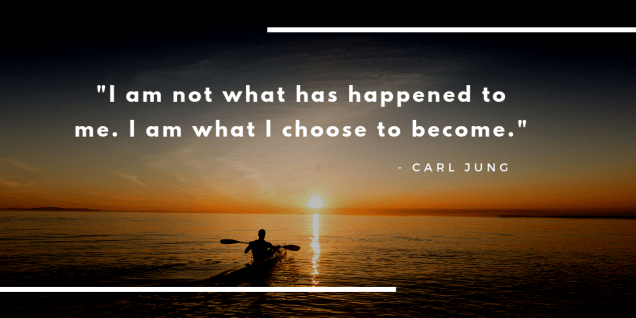
Carl Jung.png

I’m Thankful for My Mental Illness

A few weeks ago I was sitting in therapy (more on that next week!), and something occurred to me. My therapist said she’s amazed how I’m able to get so many things done despite my mental illness, which made me think of two things.

The first was that yes, I am high functioning despite my depression, but it took me six years to work up to that success. The second thing was that I’d rather be a motivated person who didn’t like himself than someone who had a ton of confidence but never got anything done.

And as we turn to a season of thankfulness and gratitude, I often think about how grateful I am for my mental illnesses. Sounds weird, right? Stay with me.

Living with depression and anxiety has taken a lot away from me. But it’s also given me so much. It’s given me strength. It’s taught me resiliency. It’s taken me from being plagued by my mental illness to becoming a force in the mental health community, and an advocate for everyone like me.

My mental illness has taught me that no matter what life throws at you, you have a chance. It might not be the best chance, or an opportune one, but it is a chance. And it’s what you do with those chances that counts.

I’d like to add that this viewpoint didn’t happen overnight. I’d knowingly lived with mental illness for more than six years before being where I am today. I’ve had highs and lows that I honestly can’t even believe. But I wouldn’t trade my experience for anything in the world.

It might be confusing to read that, and it’s kind of confusing to write, but it’s true. I’ve long held the belief that everything happens for a reason. Most of the time people have that belief when good things happen to them, but I think of it more when it comes to adversity.

So this Thanksgiving, as hard as it might be, try to be thankful for everything. Every good thing, every bad thing. Be thankful that everything that’s happened to you has made you the person you are today. I’m thankful for every bit of what life has thrown my way. It’s made me the person I am – a person I am damn proud to be. Happy Thanksgiving.